Lea Tran and Isabella Lupano
Boston University News Service
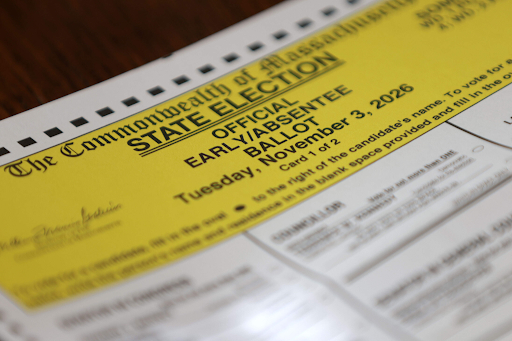
For those voting in Massachusetts this midterm election, there are nine major ballot questions voters had to answer– the most since 1992. Here is a breakdown of each issue on this year’s ballot.
- Expanding the Public Records law
Question 1 proposes a law that would make most records held by the Legislature and the Office of the Governor public records. Massachusetts is one of two states that exempt these two branches of government from the public records law. Expanding the public records law could possibly lead to more available information on financial and administrative issues from the governor’s office, according to analysts from Tufts University.
A ‘yes’ vote would make most records held by the legislature and the office of the Governor public records under the Massachusetts Public Records Law.
A ‘no’ vote would keep the current Massachusetts Public Records Law.
- Allow for the workers of the Committee for Public Counsel Services to unionize
Question 2 would specify that employees of the Committee for Public Counsel Services are allowed to engage in collective bargaining with their employer, or in other words, unionize. CPCS currently has around 500 attorneys, or public defenders, along with hundreds of paralegals and administrative staff. However, unlike other government employees, they are unable to collectively bargain under state law. If this law passes, it does not mean a union would immediately be formed, but it would be a step in that direction.
A ‘yes’ vote would allow employees of CPCS to collectively bargain with their employer.
A ‘no’ vote would make no changes to CPCS labor laws.
- Switching Mass. to all-party primaries
Question 3 would eliminate political party primaries for state elections and instead have a single, all-party primary. All candidates, regardless of their party affiliation, would be listed on one ballot. The two candidates that receive the most votes would then advance to the general election ballots. This would also require the governor and lieutenant governor to be listed jointly on the primary ballot. If passed, primaries would implement fusion voting, where candidates’ party affiliation would be listed in addition to the other political parties that endorse them.
A ‘yes’ vote would eliminate political party primaries and have a single, all-party primary.
A ‘no’ vote would mean no changes to current primary elections.
- Election Day registration
Question 4 proposes a law that would allow for individuals to register to vote or update their voter registration address on Election Day. Currently, people need to register 10 days before an election if they want to vote. This new law would allow individuals to vote at the polls if they are a U.S. citizen, over 18 years old, not legally barred from voting, show proof of residency, and sign a written oath.
A ‘yes’ vote would allow individuals to register to vote on Election Day
A ‘no’ vote would have no changes to voter registration law.
- Reforming the tax cap laws
Question 5 would change the limit to how much revenue the state can collect in a given year. This would be a change to the law, Chapter 62F, that capped the tax revenue the state could collect and to issue rebates to taxpayers if collections exceed a threshold determined by a formula considering wage and salary growth. Currently, the cap for each fiscal year is determined by a projection. This new law would determine the cap based on the actual tax collection of the previous year.
A ‘yes’ vote would change the limit on state revenue collection, basing it on prior-year collections plus average wage and salary growth.
A ‘no’ vote would make no changes.
- Setting aside state taxes for nature conservation
Question 6 would create a Nature for All fund that the state Executive Office of Energy and Environmental Affairs would be able to use for nature resource conservation. Before July 1st, 2028, only 50% of tax revenue from the sale and use of sporting goods, recreational vehicles and golf courses would be collected for their first year of operation. After July 1, 2028, 100% of the state taxes would be collected from the sale and use of sporting goods, recreational vehicles and golf courses.
A ‘yes’ vote would support creating a state fund, Nature for All funds, allowing for 50% collected until July 1st, 2028 and after 100% of the tax revenue.
A ‘no’ vote would oppose creating a fund for nature conservation efforts.
- Change Mass. zoning laws to allow for more single-family homes
Question 7 proposes a law to allow single-family homes to be built in residentially zoned areas as long as the land that it is being built on is at least 5,000 square feet with 50 feet of land bordering the street or public way. This would allow cities and towns to regulate the homes in certain aspects like the distance from other buildings and open space.
A ‘yes’ vote would support requiring cities and towns to allow the creation of single-family homes on residential lots that meet the minimum standard.
A ‘no’ vote opposes changing statewide requirements for single-family homes, maintaining the same policy in effect.
- Changing marijuana laws in Mass.
Question 8 repeals the law that legalizes, regulates and taxes the sale of marijuana for adult recreational use. The law would permit a person 21 years old or older to have one ounce or less of the total cannabis product, including no more than 5 grams of the concentrate. If the person exceeds the amount by 1 to 2 ounces, there would be a civil penalty of $100 and forfeiture of the marijuana. If the individual is younger than 21 and possesses 2 or less ounces of marijuana, they would receive a civil infraction, subject to a fine of $100, forfeiture of the marijuana and completion of a drug awareness program with community service.
A ‘yes’ vote would make changes to the current law for the regulation and possession of marijuana.
A ‘no’ vote would keep the current state laws, creating no changes.
- Keeping the Mass. 2024 gun law
Question 9 regards maintaining state control over firearms. The law adds school administrators and licensed health providers as parties that can now ask the court to issue an Extreme Risk Protection Order, requiring the individual to surrender their firearm license, permits and firearm if the individual presents a risk or danger to others. It allows courts, when issuing a Harassment Prevention Order, to require the surrender of firearms. The law imposes penalties for possessing, carrying or transferring an untraceable firearm. It develops a tracking system for the ownership of firearms. It changes the licensing requirements, requiring an individual to be 21 years or older, adds the possibility of incarceration for failure to report lost or stolen firearms, and sets a minimum age of 12-15 years old to apply for a permit for a self-defense spray. It also allows local firearm authorities to transfer responsibility to state police for inspection. The law changes the definition of machine guns to include bump stocks, trigger cranks, Glock switches, and auto sears. The Fire Control Advisory Board and state Security of Public Safety must review and update their roster of prohibited and approved firearms. The law clarifies how to determine if a firearm is an assault style type of weapon. It also criminalizes discharging a firearm and striking a building.
A ‘yes’ vote would maintain the law in place, keeping the regulations on firearms.
A ‘no’ vote would repeal the law, creating several changes to the firearm regulations.