By Briana Leibowicz Turchiaro
Boston University News Service
For 30 years, every undergraduate business student at Boston University knew they had to complete a program involving countless hours of groupwork, deep study of business fundamentals, and ultimately, a substitution of social life with library time.
This program was the CORE curriculum, now to be officially dismantled for the incoming class of 2029.
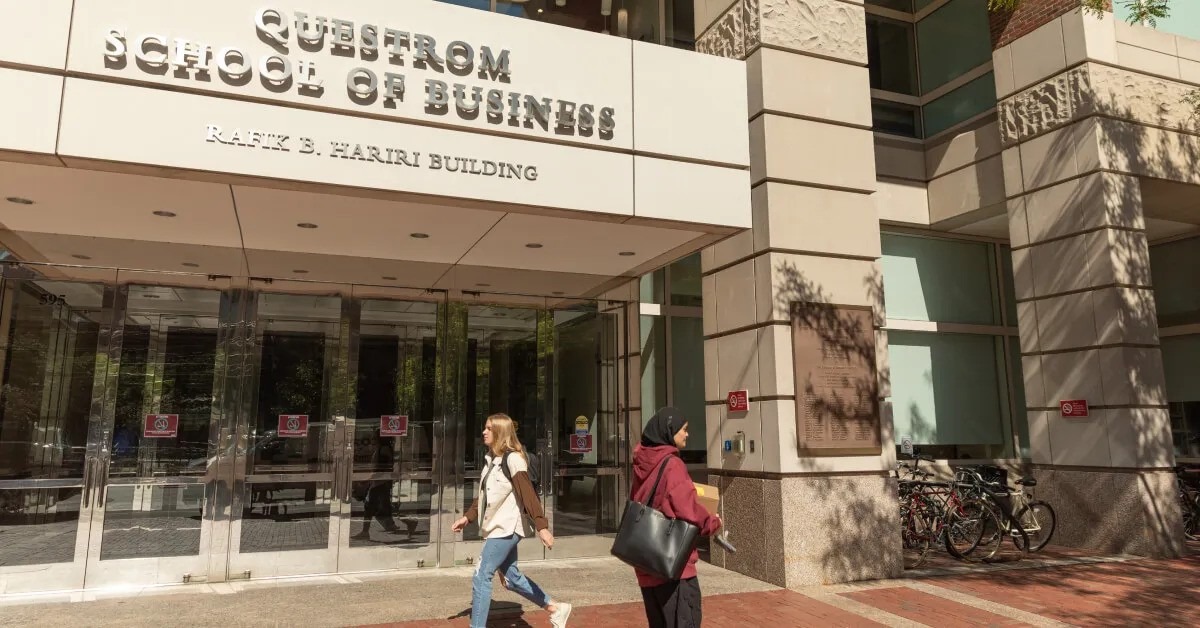
The Questrom School of Business at BU has decided to change the decades-old undergraduate curriculum with the objective of better preparing students for real-world experiences and ultimately helping students secure internships and enter the job market.
“If you don’t have at least two internships under your belt by the time that you graduate, the process of getting a job is gonna be 10 times harder, and it’s already close to impossible because of the market,” said Gauri Shah, a BU Questrom student concentrating in information systems.
Last semester, Shah said she only secured an internship by the beginning of the summer. She claimed that part of the reason why was the lack of finance knowledge. Although introductory courses taken before CORE lay a good foundation, she said students need to do work on their own if they want a realistic chance at getting an internship.
The cross-functional CORE curriculum was composed of four courses taught in a single semester. Each course focuses on a different fundamental business concept: finance, marketing, operations management, and business analytics. Alongside the courses, students were placed in teams to complete the “signature experience” — a project where teams had to design and plan a business idea or product from scratch.
Barbara Bickart, the Senior Associate Dean of Programs at Boston University, stated three main reasons behind the ultimate decision of removing CORE. She said the first is to help students better prepare for the internship processes, especially students interested in finance.
According to Mergers & Inquisitions, students looking to enter the investment banking market should attempt to network with alumni and apply to internships during their freshman year, as large banks in the U.S. usually start recruitment seasons over a year in advance. This means that if students want an internship for their junior year, they have to apply and interview by their sophomore year.
Most students take CORE their junior year, meaning they are only exposed to finance courses in their third year of college: typically during the internship application season. Because of this, students did not have the tools, experience, or technical knowledge to stand out in applications.
Jasmine Gavina, a BU Questrom student concentrating in finance and law, is currently taking the CORE program as the second-to-last group to do so. The content she is learning is aligned with the content required in recruitment processes for internships, she said.
“If I had that same knowledge my sophomore year, then I would have maybe gotten a business internship my sophomore year,” Gavina said. “But, I ended up going for law, because I didn’t feel like I was prepared for finance.”
To reconcile with this, students often try to learn independently or turn to other means like student club organizations. Abraham Budson-McQuilken, a BU Questrom student concentrating in finance and accounting, said he joined the Financial Modeling Club where they met weekly to build financial models and create spreadsheets.
“Given how professors and courses have so much structure and support, I think it really is helpful to have course work in the area you want to focus on, not just trying to supplement it by yourself through the community,” Budson-McQuilken said.
This timeline was not the case 30 years ago when CORE first started, but the dismantling of the program is aimed to keep up with the changes in these internship recruitment processes, said Bickart.
The second motivator was the weight that projects had on students’ grades. Because of the structure of the program, 25% of students’ grades were dependent on their projects. This caused professors to teach around the projects, sacrificing class time and preventing important topics from being taught in-depth, Bickart explained.
“I liked it in the sense that I got to really hone in on my people skills, and how to manage and exist with other people who are very different from me,” Shah said. “I think that’s taught me a lot.”
Shah said the challenge behind the product concept project was working with so many other students. The project consists of working with a group of ten students and spans the entire semester.
“Working with 10 people is difficult, but in a great way.” Budson-McQuilken said. “It really helps one understand how difficult it can be working with colleagues, working on group projects and trying to really build something.
The final reason, Bickart said, was the incompatibility between the innovation required from students in the product concepts project and the market advancements. She said the use of AI for research and the shift from physical products to digital services is not aligned with how CORE was initially structured.
“We wanted to give students an opportunity to be really innovative and to work with real companies while they were in the program,” Bickart said.
The product concepts were expected to be completely innovative of current products in the market, as well as be unique from previous CORE projects as well. Shah believes that removing the previous approach would help eliminate stress for students and professors alike.
“The world isn’t changing fast enough to keep up with the influx of ideas that are going to arise with the course,” Shah said.
Still, some students feel bad for younger students who won’t experience the camaraderie formed through the program.
“It made you spend a lot of time with those 10 people, and I consider them all very good friends,” Budson-McQuilken said. “I know the university’s job isn’t to arrange playdates, but I do think that was something I enjoyed and something future students might not get, which is sad.”
Three courses – with the opportunity for groupwork – will replace the former project. Students will have the opportunity for extensive groupwork: differing from CORE with its focus on innovative thinking. One of the courses, “XP 298: Innovation project,” will have students working with a “big name” client in their sophomore years, with the intention of building real-world skills and innovative thinking, Bickart said.
Bickart was a part of a team of three faculty members that pushed for removing CORE — a process that took three years to finalize.
“Core is iconic. Everybody hears about it,” Bickart said when asked about the resistance behind eliminating CORE. “It was a part of their Questrom experience and a part of their identity. So I think it’s always hard to get rid of something that has been so central to people’s identity.”
Ultimately, the decision was accepted because of extensive benchmarking research that showed how CORE was not aligned with employer’s opinions, innovations in the market, and changes in recruitment process.
Gavina said she is “a little jealous” of those students that do not have to take CORE in the future, especially since she described the program as “intense” so far. Ultimately, she thinks CORE students will be better-off without the program.
Budson-McQuilken disagrees, finding that future students will be worse-off without the opportunity. “I think getting rid of CORE is prioritizing finance students and that career path, over a broader understanding of business,” he said.
“It’s 50/50 for me,” Shah said. “Part of me thinks ‘Wow, I wish I didn’t have to do that because that semester was very difficult and draining.’ But on the flip side, I do think it was formative, and I do think that without that experience, I wouldn’t be where I am right now.”