By Madison Forrest
Boston University News Service
When Julie Hall was pregnant with her 18-year-old, a professor knocked on her door and told her she had 700 dead British soldiers buried in her backyard. “And it’s true. They’re still there,” Hall assured me. She is one of the many residents of Charlestown whose homes were built on the battlefields where the British were laid to rest.
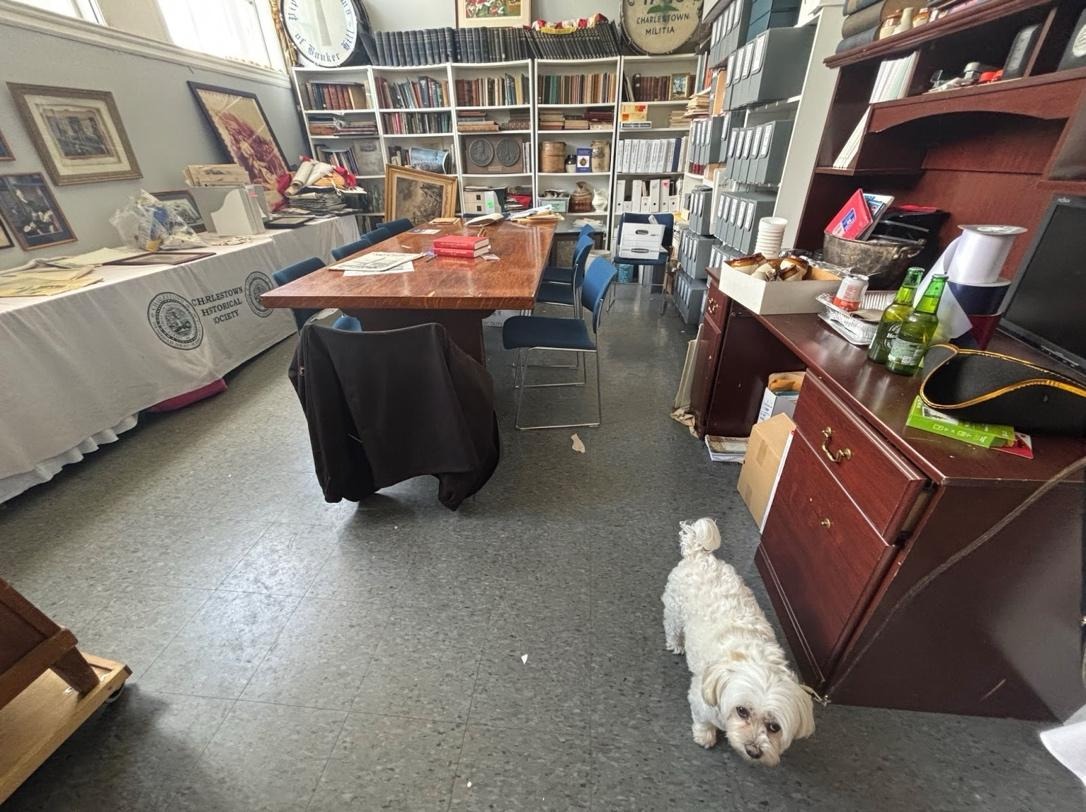
Hall and Edith open the grand, red exit door of the Bunker Hill Memorial Museum. Hall is the president of the Charlestown Historical Society and Edie is her little white dog. Edie has on a big pink bow and Hall has on a glowing tan and striking white button–down dress.
The museum lies right across the street from the 221–foot–tall granite obelisk Bunker Hill Monument. It does not literally cast a shadow over Charlestown from its sheer size, but from the lasting effects of the trailblazing battle. This was the first major conflict between the U.S. Colonies and the British Empire. Although the British won, it was incredible just how many soldiers they lost.
The Battle of Bunker Hill occurred 250 years ago, on June 17, 1775; over 1,000 British were wounded and killed, with more than 400 Americans, according to Hall. The British Empire was shocked. The American town was desolate.
We head upstairs along the white stone steps; Edie ambles. Hall lets Edie in the office first. Arthur Hurley, resident historian, and Dr. Tim Riordan, archivist, share conversation before their lunch. They are both of an age to receive a senior discount and are well respected members of the Charlestown Historical Society. Hurley is wearing a navy button down with red and white checkered lines and takes control of the room in conversation.
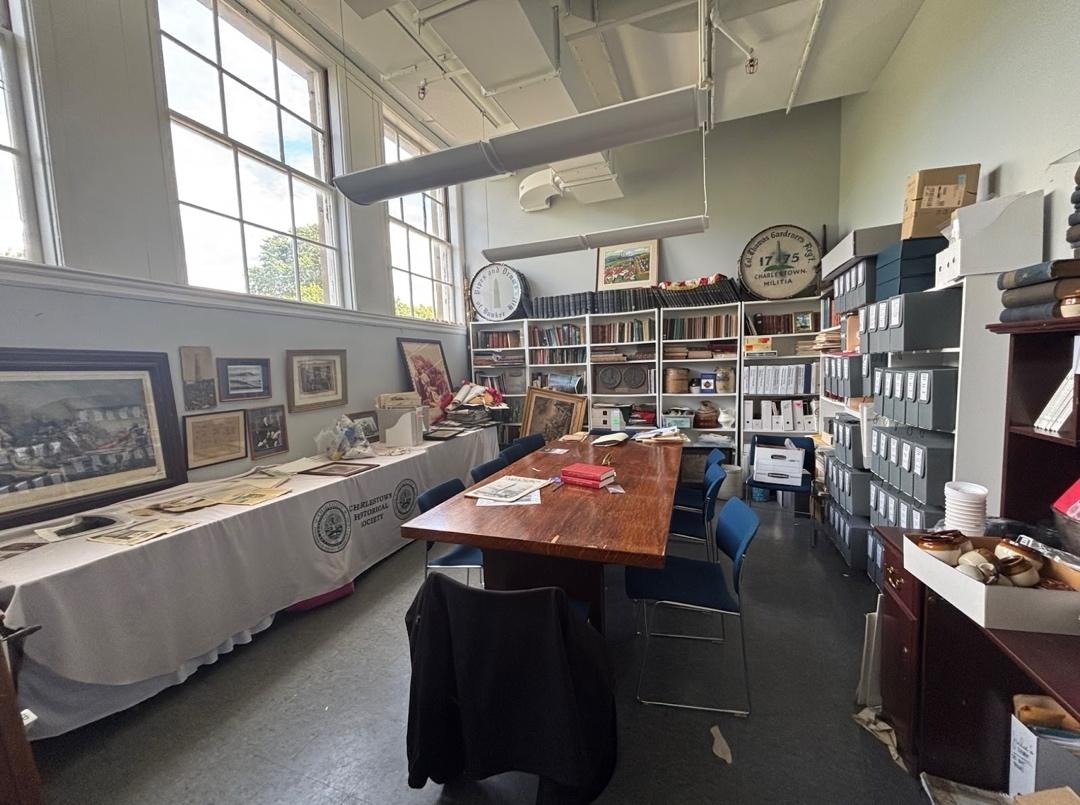
Hurley sits across from the entrance with Riordan at the opposite end of the large, likely heavy, wooden table. The chairs are uniform, navy blue and silver. Every wall has tables or book cases.
Natural light pours through high windows above a wall adorned with historical art; below this, a table and a banner with the society’s name and logo in navy over white. Hall points to the left of the scattered wall and explains, “That old picture, The Death of Warren, hangs on the wall — it shows how revered he was at the time. They even named streets and schools after him. Someone once said Warren must have had the best PR man in history.” She studied history and PR in college. There is an organized clutter on the shelves of books and historic documents, most of which were donated by people in Charlestown.
Edie never loses attention as she roams the room– her own space. Hall brings her everywhere.
Hall puts on white gloves and opens a shoe box wrapped in a plastic bag. As she uncrinkles the plastic, she explains the item inside is going to the Museum of the American Revolution in Philadelphia next year for the 250th anniversary of independence on July 4.
“This sash was worn at the Battle of Bunker Hill by a man named Tom Wheat. He died at the battle. His son carried him off the field with this sash. It came to us in a shopping bag with a note,” Hall reflects poignantly. The sash is red, woven and not too worn considering the circumstances.
While Riordan delicately sorts through and writes on documents and binders, Hurley, a townie in his 80s, tells some tales. He recounts his time in Charlestown from all townies to mostly toonies in elongated, slanted vowels.
Hurley leans back in his chair and crosses his arms and sighs. The sigh seems to be more exercised than exhausted. In his practiced Boston accent, Hurley explains, “In Charlestown, you’re either a townie or a toonie. Townies are families who’ve been here for generations, mostly Irish and Italian. Toonies are the newcomers — professionals with money to renovate. It’s been that way for decades.”
Hall tries to convince Hurley to come to a council meeting the upcoming Tuesday with two lukewarm Heinekens– their green glass glistening with droplets of water were left by the door, on her desk. Hurley argued he was tired.
“The townies used to say they’d never leave, but when the offers came, they couldn’t resist. Some of those little triple-deckers sold for what seemed like nothing back then, and now they’re worth millions,” Hurley said.
Hurley notices I am left handed like his wife and leaves with Riordan who has finished archiving for the day.
Hall continues to hop around the room and explain other relevant archives.
In between worn eulogies and business records, Hall takes a moment, smiles and divulges the following: “If there’s one thing I feel strongly about, it’s that we have to study history. We’re in such polarizing times, and history is being rewritten and sanitized. The only way we get better is by looking honestly at the past.”