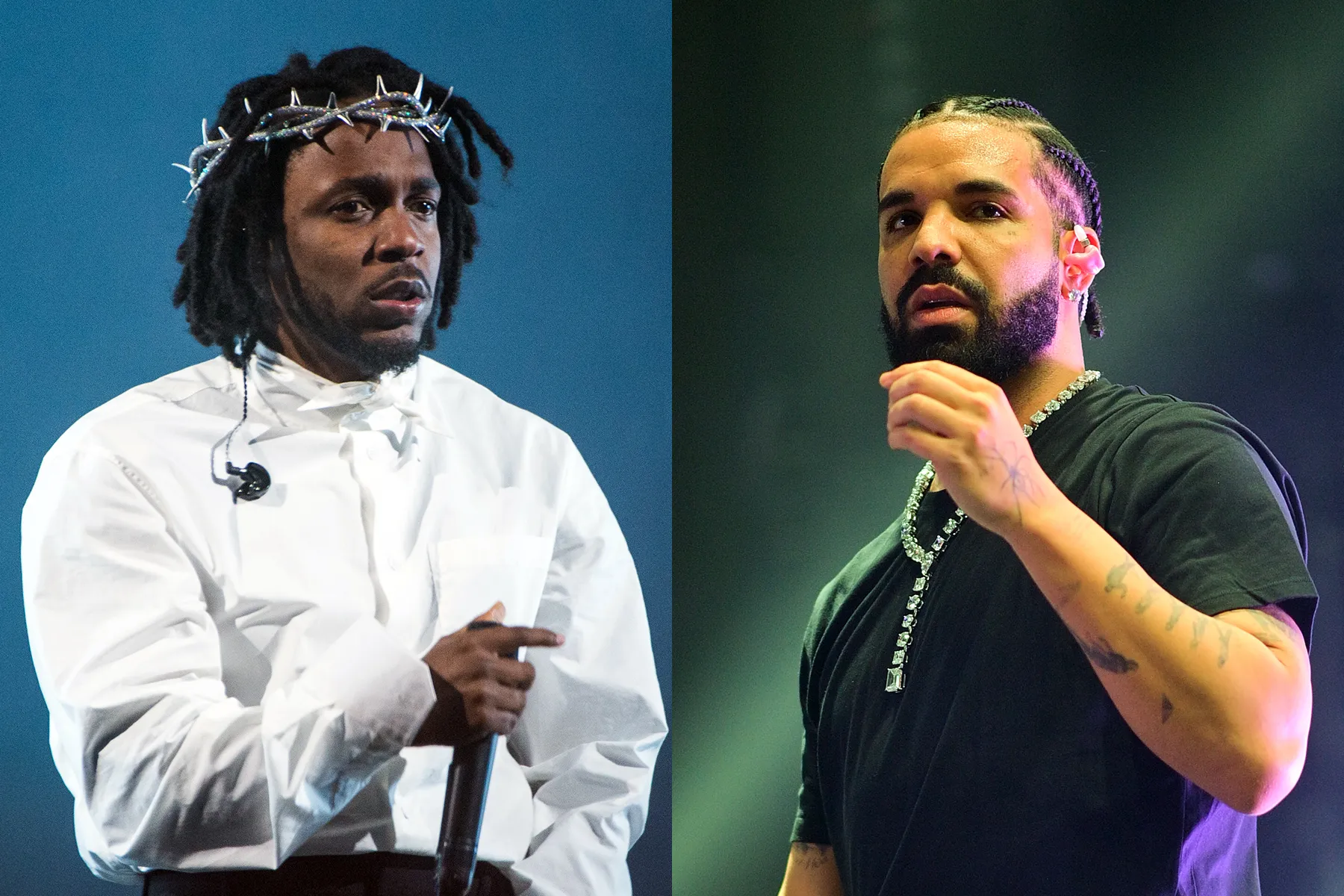
By Harry Gustafson
Boston University News Service
Even for those with little interest in football, Super Bowl LIX held an appeal for viewers who hoped to tune in to see rapper Kendrick Lamar’s halftime performance.
Lamar has been a popular rapper for over a decade since releasing his debut studio album “Good Kid, M.A.A.D. City” in 2012. Since then, his albums have received high critical and commercial acclaim, including “To Pimp a Butterfly,” “DAMN.” and “GNX,” which came out in November 2024.
However, in the past year, Lamar has been mainly recognized for his highly-publicized feud with fellow rapper Drake. What seemed like casual jabs in the beginning, first on Drake’s 2023 track “First Person Shooter” and then on Lamar’s verse on “Like That” by Future and MetroBoomin in early 2024, ended up revealing a longstanding frustration.
On “Euphoria,” the first of Lamar’s follow-up tracks to “Like That,” the rapper taunted Drake with promises to openly discuss certain information his rival might prefer to be kept under wraps. A few weeks after the release of “Euphoria,” it became increasingly evident that Lamar was not fond of his Canadian peer. After Drake released a few response songs that tried to goad Lamar into a public feud, Lamar eventually responded with “Not Like Us” in 2024.
With a highly danceable beat and an infectious string riff, Lamar openly accused Drake and his entourage of having inappropriate relationships with underage girls, as well as using the hip-hop culture of Atlanta to cement his reputation and credibility within the rap community.
The song was an instant hit. There are videos of DJs playing it in clubs just a few hours after its release. It topped the Billboard charts and earned Lamar multiple Grammy awards.
In the song, Lamar does not deem Drake worthy of his highly esteemed reputation in the rap community, accusing him of being a cultural colonizer. After all, Lamar points out that Drake is not from the urban areas of Atlanta that have forged a dominant subculture within hip-hop.
Lamar also turned his accusation of Drake’s interactions with underage girls into a resounding and catchy lyric in the hit, “Not Like Us.”
“Trying to strike a chord, and it’s probably A minor,” Lamar says, dragging that last word out for a few seconds. This lyric, in particular, became a fan favorite to sing along to.
Drake grew up in the suburbs of Toronto in a middle-class family. He first achieved fame as an actor on the Canadian teen soap opera “Degrassi” before he began his successful music career.
As long as hip-hop has existed, there have been fights, or “beef,” as it’s known in the genre. There have been numerous notable public feuds in the genre’s history. Tupac Shakur and Notorious B.I.G. had a highly public and fatal feud in the 1990s that led to the murders of both artists.
Jay-Z and Nas had their disputes, as did 50 Cent and Ja Rule. Drake himself is no stranger to public feuds as well, having been involved in prior incidents in his career, including one with Diddy in 2014 and another with Meek Mill in 2015
Before Lamar’s 2024 tracks, Drake’s most recent public feud was with rapper Pusha T, who revealed that Drake had a secret child with a French adult film star in the 2018 diss “The Story of Adidon.”
Feuding is not just unique to hip-hop, either. It can even be argued that rivalry is fundamental to the artistic process, even if it is built on friendly competition and not pure disdain.
Genres like pop and rock have seen their share of rivalry, even if no malice existed between the artists. The 1960s saw the Beatles and the Rolling Stones trying to outpace each other on the charts, despite the bands being good friends and occasional collaborators.
Additionally, the Beatles and The Beach Boys mutual appreciation for each other pushed both bands to pursue musical directions that elevated the artistic level of pop music at the time. This resulted in “Sgt. Pepper’s Lonely Hearts Club Band” and “Pet Sounds,” both regarded as two of the most important albums of the 1960s.
Another example is 1970s rockers Neil Young and Lynyrd Skynyrd, who exchanged lyrical jabs here and there. In his song “Southern Man,” Young criticized the U.S. South’s history of slavery and segregation. The members of Lynyrd Skynyrd, who are all from Florida, did not appreciate the song, believing it to paint a one-dimensional picture of the people from the region. On their hit single “Sweet Home Alabama,” they included the lyrics, “Well, I heard Mr. Young sing about her / Well, I heard old Neil put her down / Well, I hope Neil Young will remember / A Southern man don’t need him around, anyhow.”
Back-and-forth lyrical jabs are a common way for artists to vent their frustrations at each other.
Artists use these rivalries to fuel their artistic output. Competition and hating can inspire better art just as much as collaboration and affection.
Whether Lamar’s accusations and criticisms of Drake are legitimate or not, his personal vendetta against the Toronto rapper has become a huge debate in pop culture discourse over the last year.
Many point out that Lamar is being a “hater.”
For the past few years, pop culture has turned towards a false positivity culture that roundly rejects being a hater because it represents negativity. But, by equating the roles of hater and critic, Lamar is dispelling the negative depiction of being a hater.
In fact, his hating has received praise from fans.

Lamar himself does not shy away from the ‘hater’ label. “Now let me say I’m the biggest hater,” he raps on “Euphoria,” embracing the role of the hater.
He continues to express his disdain for his counterpart, saying, “I hate the way that you walk, the way that you talk, I hate the way that you dress, I hate the way that you sneak diss, if I catch flight, it’s gon’ be direct.” This part of the song was popular on video-based social media apps like TikTok.
The past decade of pop music has been largely defined by encouraging positivity. The overall landscape of pop culture seems to have rejected even the slightest form of negativity. This is evident in the number of top 40 songs about partying, dancing all night, having a good time and being careless.
Take the song “I’m Good (Blue),” a 2023 single from producer David Guetta and singer Bebe Rexha. With the chorus, “I’m good, yeah, I’m feelin’ alright / Baby, I’ma have the best fuckin’ night of my life,” the lyrics prioritize surface-level positive experiences.
That’s what makes Lamar unique as a rapper and billboard-charting artist. In addition to achieving impressive streaming and sales numbers, Lamar has received accolades, including five Grammy awards.
The rapper has always made his name with sharp social commentary. “Good Kid,” “M.A.A.D. City,” and “To Pimp a Butterfly” are full critiques of American society, particularly as it applies to Black identity, class issues, and self-image.
His Super Bowl performance also offered a lot of social commentary, most notably through Samuel L. Jackson’s cameo as Uncle Sam, a character often used as the personification of the American government, who condescended Lamar throughout the performance, Many were quick to point out that Jackson’s character in the performance was a critique of how hip-hop and other elements of Black culture are depicted and discussed by mainstream American media.
Lamar has dispelled the negative associations of being a hater. He has achieved massive success over the past year because he is a hater, not in spite of it.
With his recent diss tracks against Drake, Lamar’s sharp, acerbic lyrics focus on an individual rather than a sociopolitical system. This remains consistent with his early work and inner critic spirit remaining witty as ever.
More than simply dissing someone he has a distaste for, Lamar’s recent work is bringing a cultural shift, one where artists are not afraid to speak their minds, even if that includes being highly critical of a peer. Ultimately, this could lead to criticism of larger issues, be they social, political or systemic.
Now, Lamar doesn’t seem to be losing steam on his anti-Drake campaign. Most recently, he performed in the highly-anticipated Super Bowl LIX halftime show, performing new songs from “GNX,” hits from earlier in his career, and his Drake disses “Euphoria” and “Not Like Us.”
Lamar promised a “big surprise,” ahead of the performance, which included cameos from R&B singer SZA, hip-hop producer DJ Mustard and retired tennis champion Serena Williams.
The inclusion of Williams is no mistake, but rather a directed diss towards Drake, who maintained an on-again-off-again relationship with the athlete in the early 2010s. Her appearance suggests that the relationship did not end on the best terms.
During the performance of “Not Like Us,” when mentioning Drake’s name directly, Lamar turns directly towards the camera, smiles and struts around the stage like a victory lap. When it came time to sing the “A minor” line from the song, the entire crowd at Caesar’s Superdome in New Orleans sang along.
The hater had won.
Whether the feud between the two continues remains to be seen. For now, however, Lamar is riding a wave of success while Drake is seeking to repair his public image.