By Courtney Knight
Boston University News Service
The ice rinks at the 2026 Winter Olympics in Milan were finished hours before the final buzzer. Along the way, there were significant construction delays that turned a six year timeline into a harried race to the finish.
This has raised numerous safety and performance concerns both before and during the games. As late as December, the NHL’s deputy commissioner warned that the league’s players might skip their long awaited return to the Olympics if the rink was not up to par.
They made it to Milan, but not with pristine conditions waiting for them.
The ice has been described as a bit “softer” than normal by Switzerland women’s coach Colin Muller, and holes were forming in the ice during test events.
It’s plausible to blame the poor ice quality on the rushed job. Still, you have to consider the fact that there are three to four games each day, which adds significantly more wear and tear than an NHL or PWHL rink usually sees with one game each night.
Overall, most of the chatter about the hockey rinks has been about size differences. Hockey players are on a sheet that’s over three feet shorter than standard NHL ice, and has a slightly different shape along the corners. Both U.S. women’s player Taylor Heise and France men’s captain Pierre-Edouard Bellemare noted that this could be an advantage.
However, those participating in other sports have not been as fortunate to only worry about dimensions.
The ice has been especially problematic for short track speed skating and figure skating.
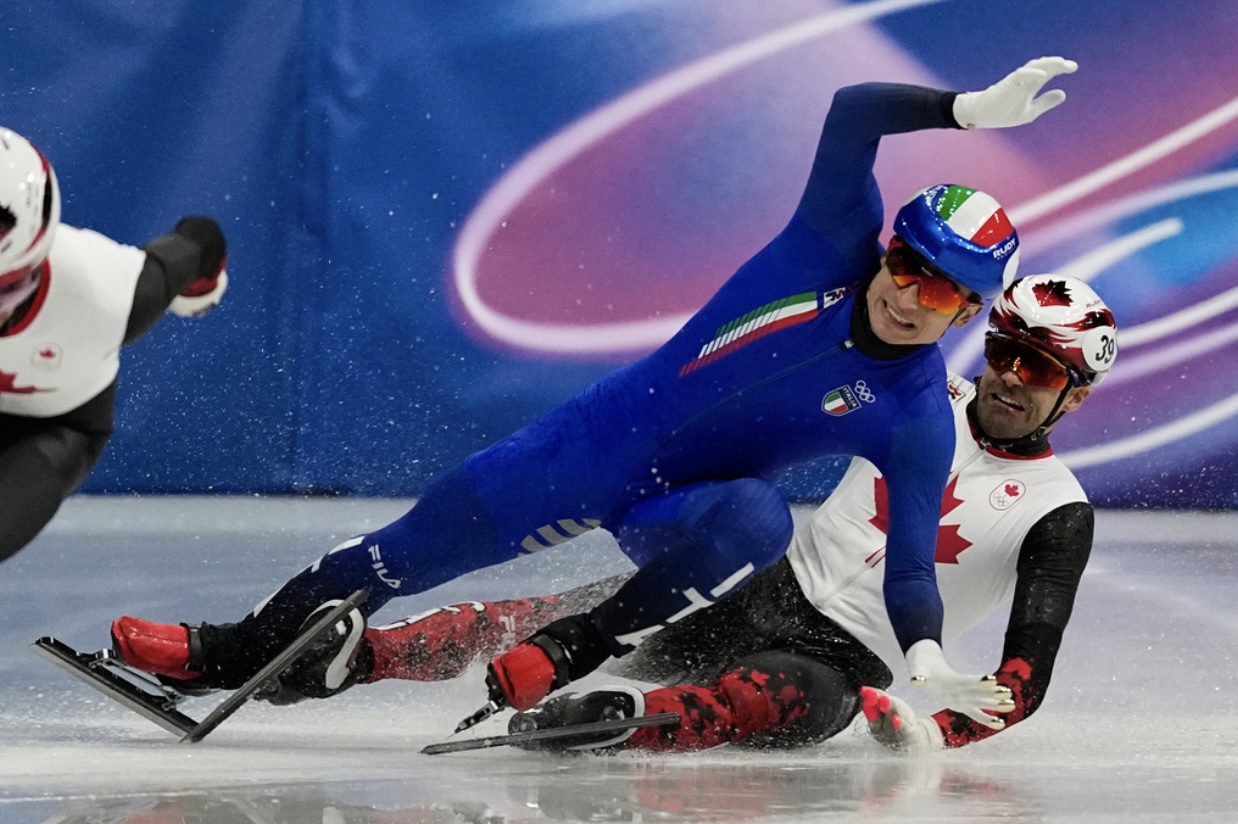
Several short track skaters from Team USA spoke out about the ice conditions following their losses. After a crash that cost speedskater Corrine Stoddard advancement in one of her best events, she told NBC, “This ice isn’t the best for short track right now.” Stoddard went on to compare the ice to figure skating ice.
Julie Letai, who experienced a similar hiccup during her race, went as far saying the ice was downright “soft”and “slushy”.
In an interview with CTV, Canada’s Steve Dubois claimed, “it’s probably the worst ice of the year we’ve had.”
It’s important to note that the ice in these rinks is fickle. Disruptions to the ice quality can arise from heat from the lights, or even humidity created by spectators — not to mention slight variations in the overall temperature, air bubbles, and water purity. This isn’t at all helped by the fact that there are so many events confined to so few venues, all of which need different things to create the best experience for the athletes.
Among figure skating and ice hockey, speed skating is the sport that needs the coldest ice conditions, and there’s no doubt the skaters feel the ice they’ve been competing on fails to meet those requirements.
And while figure skating requires the warmest ice conditions, even these athletes have commented on it, in no small part due to the number of falls during competition. The most notable of these has to be Ilia Malinin of Team USA, who went down twice during the men’s individual competition when many expected a near-perfect performance out of him.
Though Malinin mostly pointed to nerves as the reason for the mishap, he also suggested that the ice might have also played a role, saying the ice was not what he’d prefer when he spoke with the New York Times.
South Korean skater Cha Jun-hwan, who fell during his second jump element, said that the ice wasn’t bad, but admitted that his skate had some trouble moving, and cited the heat from the intense cheering as a possible cause.
The ice debacle in Milan will come to a close on Feb. 22. It’s led to crashes, falls, and devastating losses — and if for nothing else, it’ll serve as a great lesson for when France hosts in 2030.