
Briana Leibowicz Turchiaro
Boston University News Service
A Harvard student sleeps comfortably near his Resin 3D printer and UV curing station, two components of his personal set of robotics equipment. Meanwhile, his classmate works productively at his desk with prototype models scattered around his feet.
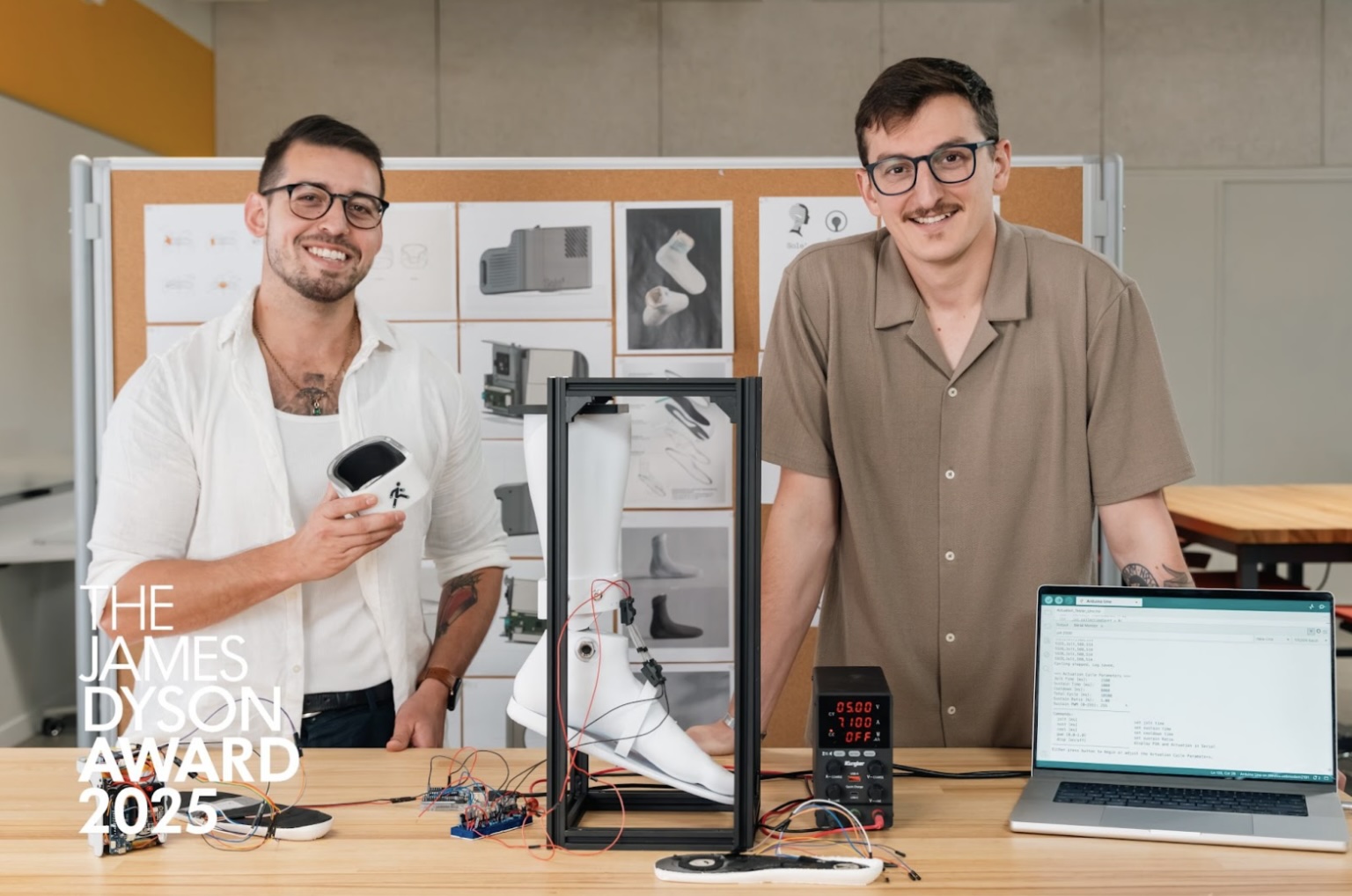
Workaholic is an understatement for students Bradly Wagman and Viktor Bokisch. Their work has extended far past classes and club organizations. The two Harvard engineering students are co-founders of Sole1, a robotics brand focused on mobility loss.
The students started with foot drop, a condition where the muscles responsible for lifting the front part of the foot are weakened, or in severe cases, paralyzed.
Foot drop can be caused by a variety of different conditions, and currently affects millions of people. In the United States alone, around 17 percent of US respondents have become familiar with foot drop, according to the Fort Worth Brain & Spine Institute.
Wagman explained that, with the frequent new advancements in artificial intelligence and biotechnology, there should also be upgrades in the treatments of these symptoms.
“There is this gap between what we have, technologically, and what is available,” Bokisch said.
Historically, foot drop has been treated with rigid braces that manually keep the foot and ankle in a neutral and elevated position. This is to counteract the foot’s inclination of moving downwards.
Sole1 aims to modernize these “medieval” mobility devices, Wagman explained. Sole1 differs — it isn’t a brace, it’s a sock.
The device is composed of an ankle bracelet and a smart sock. The bracelet has a computer that uses predictive algorithms that measure the forefoot’s angle relative to the ankle, detecting when the foot begins to drop. Based on this information, the bracelet then sends electrical signals to the filaments to correct this drop with every step.
This innovation is far from accidental. One of the students’ objectives was to prioritize a patient’s emotional state just as much as the typically prioritized physical state: a consideration that the students feel is currently lacking in the engineering field.
“If it’s moving your leg, that’s all you want,” Bokisch said when describing a lab’s typical perspective.
The current braces tend to have low adoption rates. A recent paper lists “emotional stress” as one of the primary burdens that patients reported when using these braces, possibly explaining the hesitancy in wearing them.
Researching and speaking to therapists was essential in the process of developing Sole1.
Wagman interviewed over 40 therapists and patients, all of which reported negative feelings towards the devices, even going so far as to call them “dehumanizing.”
“I’m focused on making something that increases people’s physical and mental confidence,” Wagman said.
When wearing these braces, Wagman said patients feel judged and inferior. The student said one person mentioned feeling discouraged that the device’s shape made it so he couldn’t wear his Nike shoes.
A seemingly simple thing is exactly what Wagman and Bokisch believe truly makes a difference.
“Whoever you’re designing a device for, you have to think about their whole entire environment,” Wagman said.
Bokisch said that Wagman’s plan to combine “aesthetic and fashion of a device” with focus on both mental and physical health was something he had never seen in the engineering field before.
Wagman’s inclination towards fashion and aesthetics can be attributed to his background. He previously obtained his bachelor’s degree in industrial design in Savannah College of Arts and Design.
But, academics weren’t always Wagman’s focus.
When he was younger, he didn’t take school “very seriously,” he said. Instead, he had a passion for art, filling his days with sketching and painting. In high school, he expressed this through tattoo art, even going so far as to landing a tattoo apprenticeship his senior year.
Eventually, Wagman went to the military in search of a field that merged his love for art and mechanical systems.
Bokisch also went to the military in search of something new, dropping out of his college in Barcelona after his first year to do so — a decision his parents were “livid” with.
Part of his experience connected to Sole1’s creation. During his time in Afghanistan, Bokisch worked with a special commission officer who used a fake leg.
Bokisch and the other soldiers would “crack jokes” about him. The officer would entertain these, holding his prosthetic from behind a corner, asking if anyone could shoot it. Now, looking back, Bokisch described how he was “overcoming a very significant loss of mobility” and used humor as a “facade for not caring.” He sees this officer as a case study of what Sole1 hopes to change.
Bokisch left the military after the U.S. pulled away from Afghanistan in 2022, and applied to study engineering with the objective of entering the field of assisted biotechnology.
Although Harvard’s veteran population is increasing, it is still hard to find other undergraduates pursuing engineering, especially as it is an unpopular major for veterans to pursue according to Bokisch.
In his junior year, Bokisch decided to take a robotics course. He naturally inclined towards the graduate students, as he looked for peers closer to his age, not knowing that one of them would become his future business partner.
Wagman and Bokisch developed a “sharing p-set questions” relationship, where their conversations centered around class and sharing homework.
Professor Patrick Slade, an assistant professor of bioengineering at Harvard, came as a guest lecturer in one of their robotics classes. During the lecture, Slade projected a video of a hard ankle exoskeleton, one of the current devices used to treat foot drop.
Bokisch and Slade began to go back-and-forth, discussing how to fix an issue in the device’s design: as the exoskeleton was flexing, it would drive the user’s knee backwards and the person’s body forward.
“Immediately you could tell this guy [Bokisch] was just extremely gifted at robotics,” Wagman said.
The class incentivized Wagman to reach out to Bokisch to learn more about the issues he was discussing with Slade.
As Bokisch described, the two had a “chemistry of connection,” and the first ideas for Sole1 began.
The first two months in the process were packed with planning and preparation before the official incorporation in January, earlier this year.
The entire process occurred while the pair continued their studies. Wagman is pursuing a master’s degree in design engineering, while Bokisch is in his senior year for a bachelor’s degree in bioengineering.
Balancing their studies and Sole1 weighed on the students, especially in the beginning stages of the incorporation process.
“It’s just this huge process so you’re in all these meetings and doing all this stuff and on top of it you have an essay to write about some random topic like Medieval Mexico,” Bokisch said.
The pair really managed to focus on the project this past summer, after the rush of the spring semester. The fruits of their effort became evident by the accomplishment of winning the James Dyson Award (JDA) in September 2025.
The coverage from the JDA rewarded the two with funding and helped the project gain more traction and public attention. The aftermath of the JDA was an unexpected surprise for the students.
“I’m a sniper,” Bokisch said when asked about his reaction to winning the award. “My whole job was nobody knew who I was, or where I was, or what I was doing.”
The veteran’s current exposure served as a sharp contrast to his previous occupation.
Currently, Sole1 has resolved the immediate technical problems, and are now working through the logistics and bureaucratics involved in a start-up.
Wagman hopes to eventually incorporate machine learning into the creation to make the device even more personalized.
The hope for the future is to continue applying Sole1’s unique technology of soft robotic textile to other areas of the body dysfunctions, Bokisch said.
Both students have frequently gone against the norm of expectation, so it does not come at a surprise that their inventions did too.
“There are people that have seen this work and say, ‘I need this,’” Bokisch said, “No one else in the world except me and Bradley know how to make this right now, so it’s gone from being a side project to a responsibility.”