By Brogan Ringgold
Boston University News Service
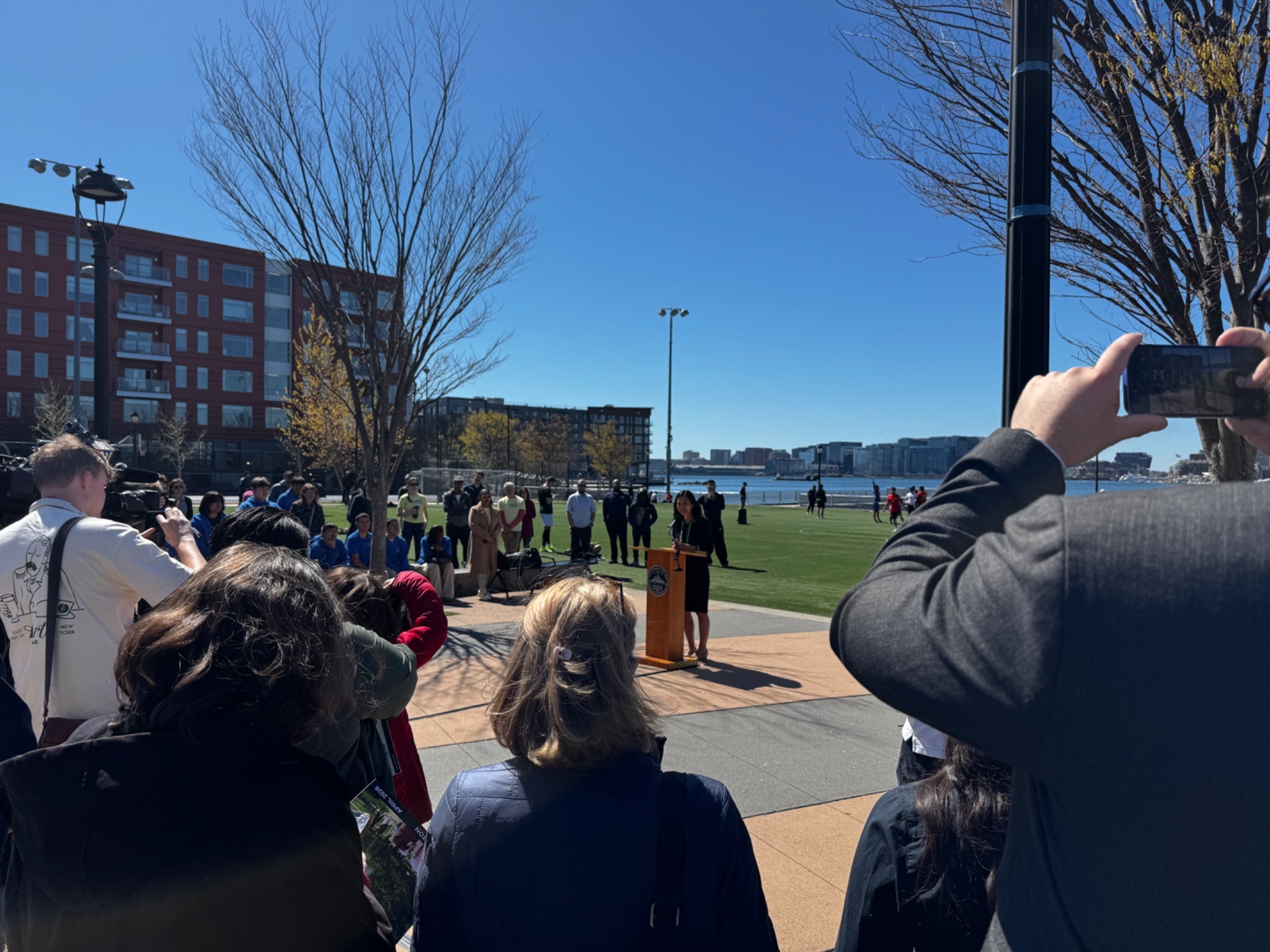
Boston Mayor Michelle Wu unveiled the city’s 2030 Climate Action Plan in defiance of the Trump administration, leading the national charge against climate change at LoPresti Park in East Boston.
Joined by State Sen. Lydia Edwards and City Councilor Gabriela Coletta Zapata, officials and other developers of the city’s plan showed a united front while outlining goals to reduce carbon emissions, expand the number of trees across the city and prioritize resources to low-income neighborhoods.
“As we are seeing a vacuum of leadership or even outright attacks against our communities by the federal government, we need to do more than just envision,” Wu said.
The plan focuses on implementing more decisive policy moves over the next five years that impact all of Boston–the first plan to do so, according to Wu.
“We know the threat that climate change poses,” she said. “But unlike our federal government, Boston is not hiding from that reality.”
Zapata praised Wu for being a leader against the Trump administration, setting an example for cities across the United States.
“Baby Zapata is not here yet, but he’s coming very soon,” said Zapata, who was pregnant. “I feel at ease about his future, knowing that amid the hostile and regressive acts by the federal government, the rollback of regulations that we haven’t really seen before, that we have local leadership here, who is making this a priority.”
Reducing urban heat and expanding cooling access was one key move in the city’s plan, with efforts to rapidly expand the number of trees that are planted across the city. The mayor touted a new arborist task force that not only plants new trees but ensures their survival.
“For the first time ever, we have seen a real increase in our tree canopy coverage,” said Wu. “This is not by accident.”
One pivotal group in this effort, according to the mayor, is Tree Eastie, a community-based urban forestry program. Tree Eastie has planted over 732 trees across the city and in Boston residents’ yards since 2019.
“We are going to get to hit 1000 this year, maybe, if not by the end of this year, by next year,” said Bill Masterson, executive director of Tree Eastie. “We want to be able to expand the tree canopy, which is at 7%, to the city average, which their goal is 30%.”
“That’s going to require a lot of trees,” he said.
With these policies, the city also aims to reduce community-wide greenhouse gas emissions by 50% in 2030 and reach 100% carbon neutrality by 2050. However, the city is already 48% of the way to this 2030 goal.
“What’s important to highlight is that this means we are not about coming up with big new targets,” said Oliver Sellers-Garcia, Environment Commissioner and Green New Deal director. “We’ve known for a while what we need to do. It’s all about doing it right, doing it effectively, and doing it in adjustment.”
Wu’s office is also calling the climate action plan a climate justice plan, emphasizing that underserved communities are disproportionately affected by climate change.
“By centering climate justice foundationally in our plan, we will ensure that climate action appropriately benefits all Bostonians and acknowledge decades of environmental justice in our collective history,” said Brian Swett, Chief Climate Officer.
Wu said her and her administration will continue to engage with residents to further equitable actions, which includes young Bostonians.
Wu ended the event by planting a tree with the help of Advanced Placement Environmental Science students from East Boston High School.
“Our goal every day is to make Boston the safest, greenest, healthiest, best place to raise a family, a home for everyone,” she said.