By George Lehman
Boston University News Service
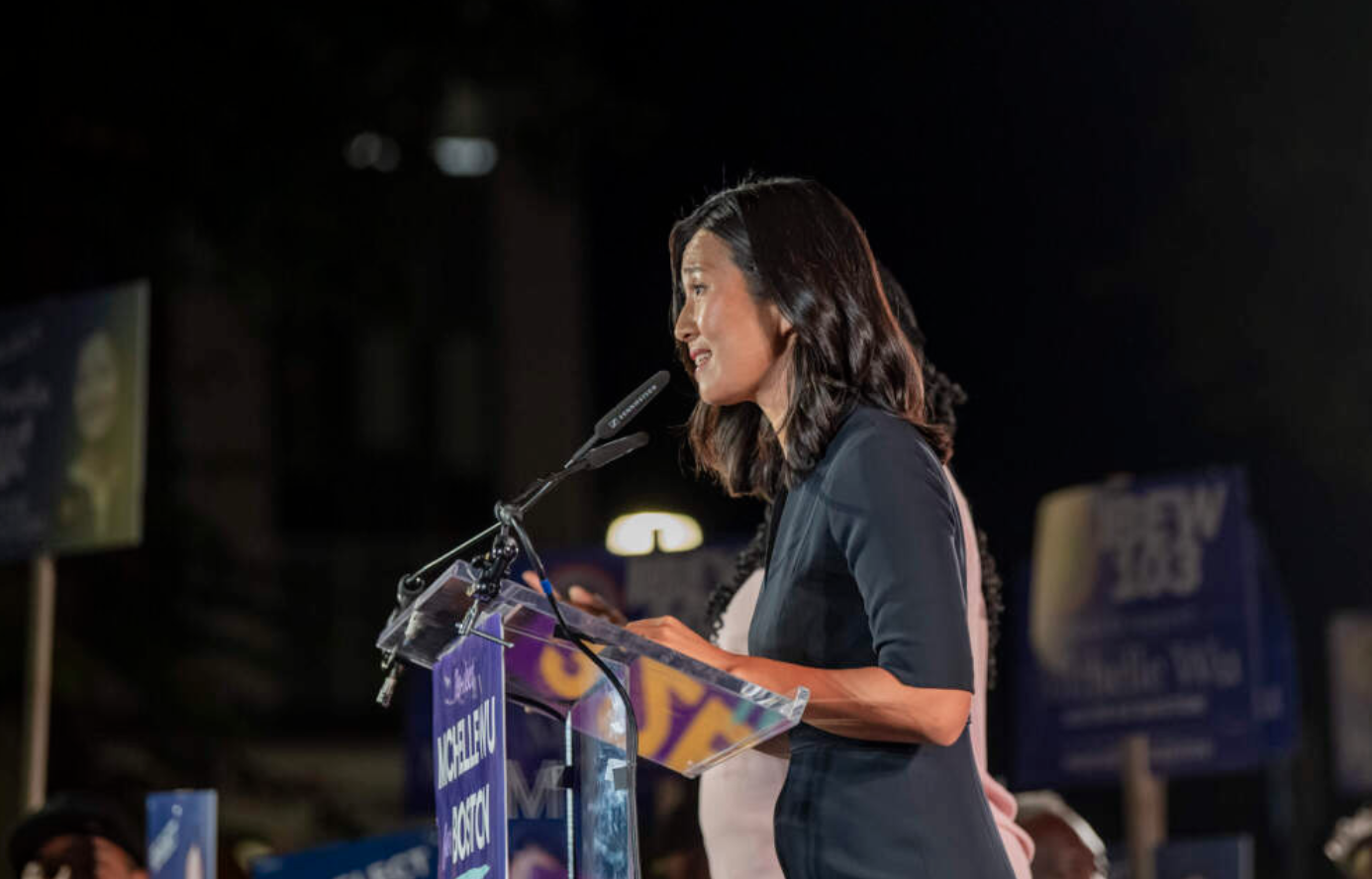
When voters turn out to the polls today, they will find only one candidate on the ballot for the next mayor of Boston. After her main challenger withdrew his name and no other candidate gained enough votes in the city’s preliminary election back in September, incumbent Mayor Michelle Wu is now running unopposed in this year’s general election.
Ahead of Boston’s preliminary election, philanthropist and son of the New England Patriots’ owner Josh Kraft was the most likely challenger to Wu, but dropped out of the race in September after receiving only 23% of votes compared to Wu’s 72%.
Born in Chicago, Illinois, Wu pursued a bachelor’s in economics at Harvard University before attending Harvard Law School. According to the City of Boston’s website, Wu started her career in public service while interning for former Boston Mayor Tom Menino.
Wu was first elected as Mayor of Boston in 2021, becoming the first woman and first person of color to hold the seat. She took office two weeks after Election Day to fill the mayor’s office when former Mayor Marty Walsh left the position after being appointed U.S. Secretary of Labor during the early years of the Biden administration.
Before taking office, she served as the first Asian American woman to serve on the Boston City Council as an at-large city councilor for eight years. She has taken a progressive stance with policies, including the expansion of Boston Public Schools’ Pre-K and early education, divesting city funding from companies profiting from fossil fuels and extending the MBTA’s pilot fare-free bus program until March next year.
Wu officially launched her re-election campaign in April earlier this year, where U.S. Rep. Ayanna Pressley endorsed the mayor. Wu has also gained the support of other high profile Massachusetts Democrats with endorsements from senators Elizabeth Warren and Ed Markey and more than 40 organizations and unions.
While delivering her State of Schools Address last Tuesday, Wu spoke on her administration’s policies for Boston Public Schools going forward, but also touched on the Trump administration’s policies for federal funding.
“Boston has been a target in the federal political storm,” Wu said. “We’ve had grants pulled, funding cut and even as we do everything we can to protect our communities, we’ll have some hard decisions to make.”
In September, the U.S. Department of Justice sued Boston along with Mayor Michelle Wu and Police Commissioner Mcihael Cox on claims the city’s sanctuary policies “obstruct” the federal government from enforcing its immigration laws.
Boston’s MBTA system was also brought under scrutiny by U.S. Transportation Secretary Sean Duffy after sending a letter to MBTA General Manager Phillip Eng in September requesting information “on the agency’s practices and expenditures.” Direction to use capital grants for expenses relating to preventing crime and security measures was also mentioned in the letter.
“Federal transit law explicitly permits recipients to use capital grants for capital expenses related to crime prevention and security activities,” the letter reads. “MBTA should target Federal resources expeditiously and appropriately for these eligible activities, particularly at South Station.”
While this year’s race for mayor is uncontested, Tuesday’s ballot will also have eight candidates vying for four at-large city councilor seats up for election. As reported by the Boston Globe, “Wu has said she voted for three candidates” in September’s preliminary election, including City Council President Ruthzee Louijeune, At-Large City Councilor Henry Santana and Alexandra Valdez, the director of Boston’s Office of Cultural Affairs.