By Cal LaFauci
Boston University News Service
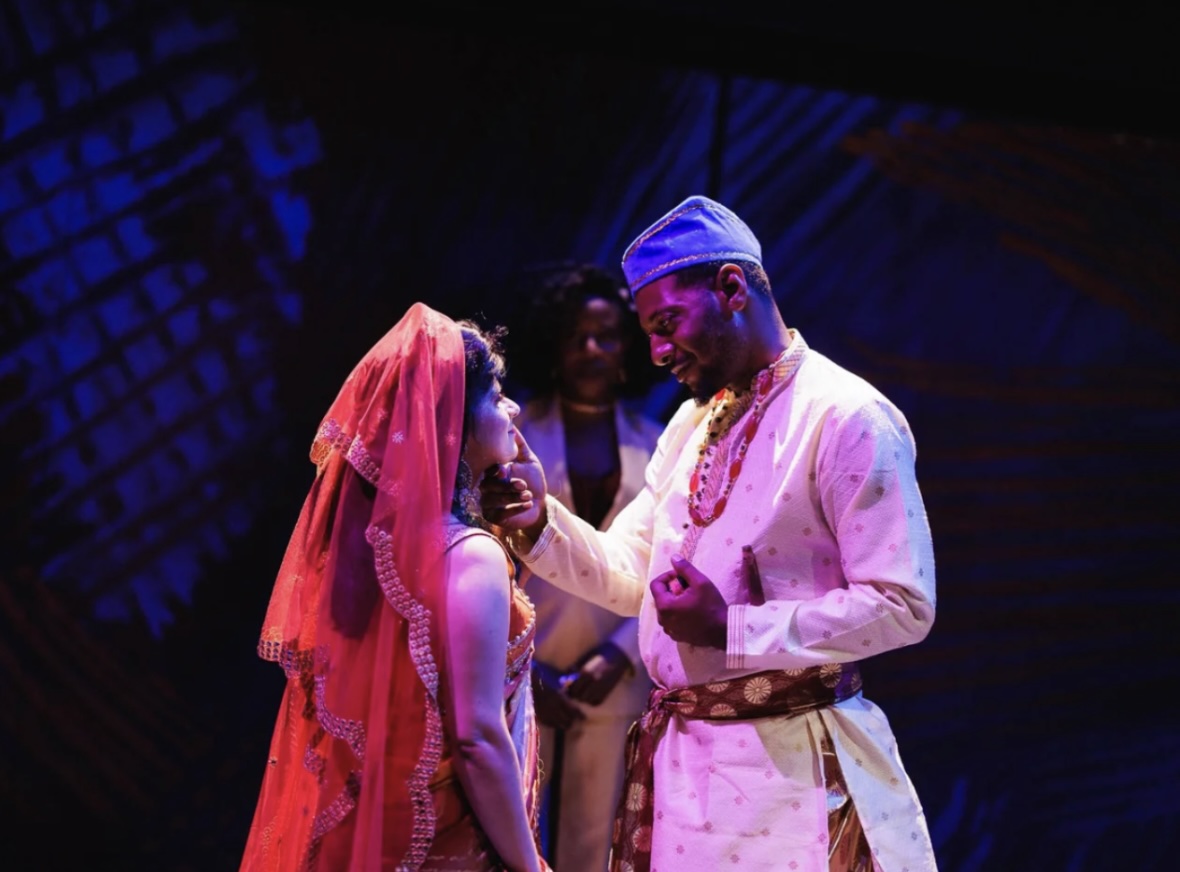
The love woven through every aspect of “The Ceremony” emerges as a celebration of the people who partake in Nepali and Nigerian wedding traditions that audience members can see, feel, and engage in. Through several labors of love with the script, the production, and the receptions surrounding it, the cast and crew of “The Ceremony” curated an experience that brings guests closer to the Ufot family than any of the previous plays of the Ufot Family Cycle have before.
“The Ceremony” is the sixth installment in the Ufot Family Cycle, a two year festival occurring across the Boston area that follows several generations of the Ufot family over the course of nine plays written by Mfoniso Udofia. This play centers around Ekong Ufot and his fiancée, Lumanthi Rathi, who originally planned for their dream wedding to go on without either of their fathers’ present. However, when Lumanti’s dad has a change of heart, Ekong must decide whether or not he wants to welcome his dad back into his life after ten years of distance.
It began rehearsals on August 12 and continued to rehearse changes to the script, blocking, and choreography until opening night on September 19. The production involved a wider range of partners than any of the cycle’s previous plays, including the Boston University School of Theater, Boston Playwrights’ Theater, the Huntington, and CHUANG Stage.
When it came time to write the script for “The Ceremony”, Udofia had to learn how to balance the heaviness of the Ufot family’s recurring intergenerational struggles and this show’s central themes of reconciliation and love.
“I like to think of myself and my work as a rubber band,” Udofia said. “As I push harder into the tough stuff, I’m pulling in the other direction towards light. And so, what I took away from ‘The Ceremony’ was that with the hardest of the hard, I need to find even more peace in my writing.”
Udofia does exactly what she set out to do by weaving the harder-to-talk-about themes through displays of interfamilial, sibling, romantic, and self-love throughout the play. Interfamilial bonding occurs between the characters from the second the lights go up to the final celebratory scene before the bows. Children and their fathers attempt to reconcile and fix the broken links in their relationships. Siblings hold each other close when they think one of them might stumble. Romantic partners experience every high and low point that comes with loving someone as much as, if not more, than yourself.
Even side characters such as Mr. Johnson, who appears once and never again, has an entire storyline where he goes to Ekong’s physical therapy clinic with the hope of running a 5K with his daughter to celebrate her being two months off drugs. When one character shuts down or tries to isolate themself, the other characters continue to fight for them until that character recognizes their worth. They love each other throughout the good, the bad, and the ugly. Their affection persists, even when things get hard.
Guests hear this affection in the characters’ speech patterns just as often as they see it in their faces and actions. Many lines combine English with the characters’ native languages of Nepali, Sanskrit, and Ibibio. No subtitles or translations occur – except for one part which comes from a place of interfamilial love – but the audience still understands the characters’ affection for each other, even if they do not understand the meaning behind each spoken word.
“It’s like Shakespeare,” Aisha Akorede said. She played the younger version of a character in “The Ceremony”, Toyoima Ufot, in the second play in the cycle, “The Grove”. “We don’t go around speaking Shakespearean but when we read his work, we feel what he’s saying. That’s what I love about Udofia’s work.”
After the performance concludes, the audience gets the chance to soak in the love that “The Ceremony” invokes through the inclusion of CHUANG Stage’s wedding receptions – the only play in the cycle to include such an event. These celebrations are designed to help guests develop a deeper bond with the Ufot family and celebrate the connection between the characters’ Nigerian and Nepali cultures. Each reception switches between offering free food by Comfort Kitchen, providing live music from one of four musicians – Giri Subramaniam, Anju Madhok, Tim Hall, and Clef Nite – and presenting organized conversations with members of the cast and crew. Although most of these events occur after the show, some days activities such as free chai-tasting sessions or group dances occur beforehand, with the hope of getting guests in a celebratory mood. CHUANG Stage curated each reception so that – no matter what is offered – guests enter and leave the Joan & Edgar Booth Theater with a lingering feeling of warmth in their chest.
“I’m really happy that we get to have that warm hug that everyone gets to be welcomed into and still have that warm hug when they come out,” CHUANG’s marketing and communications associate, Jennie Jacinto, said.
“The Ceremony” runs from Sept. 11 to Oct. 5 at the Joan & Edgar Booth Theater with CHUANG Stage’s pay-what-you-can ticket pricing.