By Amanda Brucculeri
Boston University News Service
The Boston Marathon holds the title of being the world’s oldest annual marathon. This Monday, April 21, marks the 129th year of runners taking to the streets of Boston to complete the 26.2-mile race route. But before the marathon became what it is today, it went through a few major changes over the years.
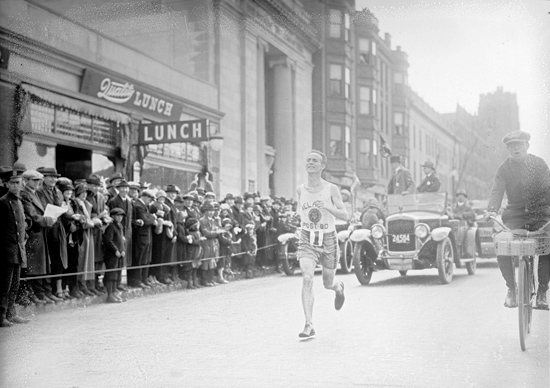
The Boston Marathon can be traced all the way back to 1897, when it was first held on April 19. It was organized by a man named John Graham, who was a Boston Athletic Association member and United States Olympic Team Manager. He was inspired by the 1896 Summer Olympics, which held the first marathon competition. The first Boston Marathon’s route was 24.5 miles and began at Metcalf’s Mill in Ashland. The race concluded at the Irving Oval, a running track that was located near Copley Square.
By 1924, the marathon had undergone some revision to its route and length. The length of the course was extended to 26.2 miles to comply with the new Olympic standard. The start of the race was also moved west to Hopkinton, the town where it starts now and where it all begin today.
While the course itself has undergone changes over the years, so have the regulations for eligible participants. Women were only officially allowed to run the marathon starting in 1972, and wheelchair divisions were added for men in 1975 and in 1977 for women. In 2017, handcycle divisions were added.
The day that the marathon is held has also been moved around over the past 129 years. The Boston Marathon was held on Patriots’ Day, April 19, from the race’s start until 1968. In 1969, Patriots’ Day was changed to be celebrated on the third Monday of April. Consequently, the Boston Marathon has been held on April’s third Monday.
Until 2005, the race kicked off at exactly noon, but starting in 2006, the marathon implemented a staggered start, meaning there were two waves of runners that started at different times. The first wave of runners started the race at noon, and consisted of top-seeded runners, as well as 10,000 other runners. The second wave crossed the start line 30 minutes later. Today, there are four waves of runners, with the first wave beginning at 10 a.m.
As the Boston Marathon returns to the streets this Monday, it continues to celebrate over a century of athleticism. Despite changes to its distance and route among other factors, the marathon has become a symbol of tradition: and runners will continue to gather for years to come.