
By Nathan Metcalf
Boston University News Service
The race for Massachusetts’ 4th Congressional District is ramping up as Rep. Jake Auchincloss, a Newton Democrat first elected in 2020, seeks reelection while facing challenges from two progressive Democrats and a Brookline candidate running an unconventional Republican campaign.
Brookline resident Tom Stalcup, a physicist who chose to run with the GOP in the heavily Democratic district, entered the race alongside Democratic challengers Jason Poulos, an AI researcher from Sherborn, and Chris Boyd, a public school teacher from Bellingham.
For his part, Auchincloss is focused on “defending democracy in Washington, lowering prices in Massachusetts, and paving the path forward for a stronger Democratic Party,” said spokesperson Georgina Burros in an emailed statement.
Another Brookline Democrat, Ihssane Leckey, announced in February her second bid for the seat after finishing fifth in the 2020 Democratic primary. She withdrew from the race on April 7, citing insufficient resources to mount a competitive campaign.
According to Federal Election Commission filings, Steven Chasse has also registered as an independent candidate but has not responded to multiple requests for comment from Brookline.News.
All three competitors, none of whom has held elected office beyond a Brookline K-8 school council, face steep competition from Auchincloss, who ran unopposed in the 2024 Democratic primary and general election.
Despite the uphill battle, each told Brookline.News about why they believe they can unseat the incumbent ahead of the Sept. 1 primary and Nov. 3 general election.
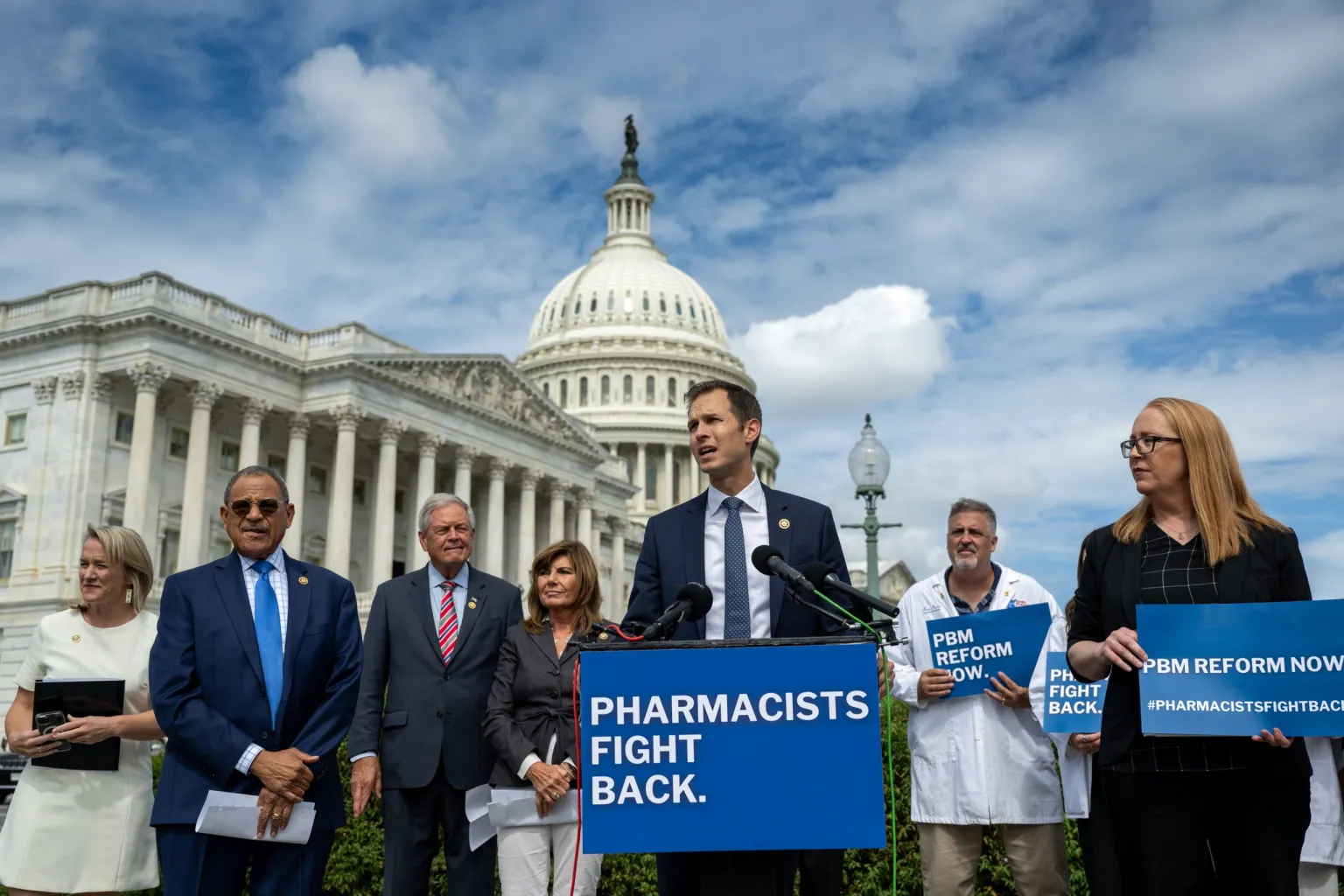
“I’m not the typical Republican in Massachusetts,” said Tom Stalcup, a Brookline physicist and owner of a business that designs software for remote weather stations, who is running on a platform centered on lowering drug prices and reducing U.S. military intervention abroad.
Stalcup said he is running “to solve this crisis in our country of affordability,” with lowering drug prices as the core plank of that plan.
“In Brookline, the main reason there’s an override this year is all the benefits we pay for the employees of the town, which is directly related to health care costs, and they’re just going up, they’re skyrocketing,” Stalcup said. “The big driver to that is pharmaceutical prices. And Congressman Jake Auchincloss is repeating the talking points of the pharmaceutical lobby … and they’re the people funding his campaign.”
Stalcup said that position reflects his rift with the modern Democratic Party, which he perceives as captured by corporate interests.
“I’m actually a big Bernie supporter — I wanted him to win. I was a liberal Democrat all my life,” Stalcup said, adding that his break from the party came after “Hillary Clinton’s campaign basically colluded with the DNC to rig the campaign against Bernie in the primary.”
Since 2016, Stalcup had been a political nomad but began gravitating toward Republicans under Trump because he perceived alignment on reducing U.S. military entanglements abroad.
“I’ve been anti-war my whole life,” Stalcup said. “The one thing I really liked about the transition recently for the Republican Party on the national stage was their non-interventionist policies.”
Trump’s second term has left Stalcup frustrated with the political establishment once again; however.
“Trump’s adventure in Iran now has made me feel that I will not shy away from speaking out publicly against the foreign policy of the current administration.”
Disillusioned with the establishments of both parties, Stalcup ultimately landed on the GOP because of a greater perceived tolerance for ideological diversity.
“I do not believe the Democratic Party would welcome a candidate like me,” Stalcup said. “Until about three months ago, I was independent. I changed to the Republican Party because it was required for me to run as a Republican.”
Stalcup would face off against the Democratic primary winner in November.
“I’m not a politician. I’ve never run for office before,” said Jason Poulos, 40, an AI researcher from Sherborn with a PhD in political science who is conducting postdoctoral research on AI at Harvard and is running a campaign centered on the economic disruptions posed by AI and the influence of corporate money in politics.
“That’s why I’m running principally, because I don’t think many people in Congress right now are taking the threat of AI-related worker displacement seriously,” Poulos said.
Such a reshaping of the economy requires creating a more robust social safety net, Poulus argues. “That’s why I’m a big advocate for Medicare for All, to decouple health insurance from employment. I’m an advocate for a universal basic income to provide workers a floor on which they can survive,” he said.
Poulos has also made overturning Citizens United and reducing the role of money in politics central to his candidacy, arguing that “we’re seeing a new kind of oligarchy, where money from industries like AI, crypto, and pharmaceutical companies is shaping policy.”
That influence extends to Auchincloss, Poulos said, pointing to the congressman’s positions on drug pricing and foreign policy, which he argues align with his donors’ interests. Publicly available data compiled by OpenSecrets shows that between 2019 and 2024, Auchincloss received $400,322 from pharmaceutical and health companies and $547,380 from Pro-Israel groups .
Poulos said his proposals would be funded through higher taxes on top earners and corporations, as well as a tax on automation, but argued that concerns about cost are often applied selectively.
“Nobody asks how we’re going to pay for wars or military spending, but they always ask how we’re going to pay for programs that help people,” Poulos said.
“As a teacher, you see firsthand how policy affects people’s lives,” said Chris Boyd, 31, of Bellingham, who teaches middle school music and is running as a Democrat with a campaign focused on affordability.
“It’s not abstract,” Boyd said about rising costs of living. “It’s real for the students and families we work with every day.”
Boyd acknowledged that his platform overlaps heavily with Jason Poulos’s, with both campaigns calling for Medicare for All, overturning Citizens United, implementing a universal basic income, canceling student debt, instituting rent control or stabilization, reducing corporate influence in politics, and conditioning or ending U.S. support for Israel.
“Our platforms are pretty well aligned for the most part,” Boyd said.
He did, however, contrast his background with Poulos: “My experience isn’t rooted in white papers, academia, and research. My experience is rooted in working with everyday families who are struggling.”
Among Boyd’s standout proposals is expanding the House of Representatives to create smaller, more locally representative districts.
“The priorities of people in Brookline and Newton are going to be very different than the priorities of people in Fall River,” Boyd said.
He has also proposed expanding federal job training programs. “One of the ideas that I’m really proud of is … bringing back New Deal–era programs like the Works Progress Administration to give a job to every single American who wants one,” Boyd said.
Boyd also sharply criticized Auchincloss’s record in office, arguing the incumbent has been inconsistent in his values and too closely aligned with donor interests.
“When I look at our representative in our district, I don’t see someone who has that everyday experience… I see a multimillionaire … who takes millions of dollars from corporations and special interest groups, despite saying that he’s supposedly against it,” Boyd said.
This article originally appeared in Brookline.News.